Learning Arabic does not open one uniform “Arab world.” It gives you a way into many communities, histories, and creative traditions that share a language while speaking it differently. A translation can tell you what happened in a story. Learning to read and listen for yourself lets you notice which words a writer chose, how someone greeted a guest, and what a sign or song is doing in its own setting. You do not need fluency to begin.
Read stories and ideas in their original words
Arabic connects today’s readers with poems, novels, reporting, children’s books, film subtitles, and older manuscripts. UNESCO’s World Arabic Language Day overview describes the language’s contributions to poetry, philosophy, and the exchange of knowledge. That history is worth exploring, but start small: read the title of an article or a short bilingual passage and look for words you can recognize again tomorrow.
Take the family built around ك-ت-ب, associated with writing: كتاب is a book, كاتب is a writer, and مكتبة is a library or bookshop. Their meanings are related, not interchangeable. Recognizing the pattern helps you make sense of a passage, while context and a dictionary still matter. Try comparing one paragraph with a published translation, then ask why the translator chose a particular English phrase.
Hear the difference between written Arabic and local speech
Modern Standard Arabic gives learners access to books, news, and formal communication across countries. Everyday conversations usually draw on regional varieties. A learner might meet كيف الحال؟ (“How are things?”) in a lesson and hear إزيّك؟ (“How are you?”) in an Egyptian conversation. The second expression is one informal form; it changes with the person being addressed. Neither phrase represents every Arabic-speaking community.
Notice the setting as carefully as the words. Who is speaking to whom? Is the conversation formal, playful, or intimate? Reading a standard article and listening to a regional interview build different, complementary skills. If your goal is to read across borders, Modern Standard Arabic is a useful foundation. If you hope to spend time with a particular community, learn its local speech alongside it. Our guide to MSA and spoken Arabic can help you plan for both.
See culture in its details, not as a single stereotype
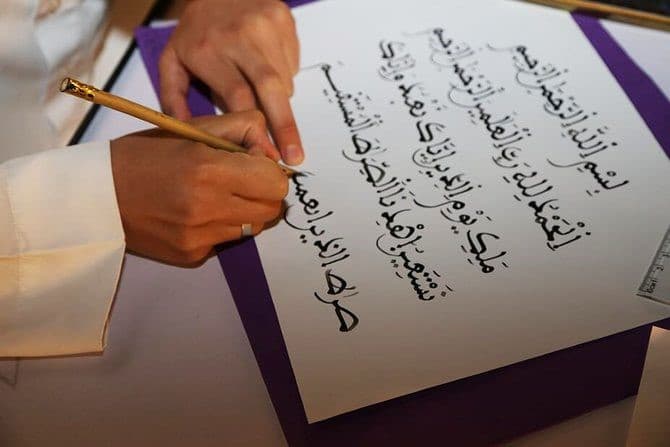
Arabic appears in street signs, contemporary design, family messages, historical documents, and sacred texts. Learning the script changes what you can notice: letters take different shapes according to their position in a word, and artists can stretch and arrange them deliberately. UNESCO recognized Arabic calligraphy as intangible cultural heritage in 2021, noting both its traditional methods and modern forms.
These are invitations to look more closely, not evidence that all Arabic speakers share the same customs. A Moroccan novel, Lebanese song, Sudanese interview, and Palestinian recipe come from particular people and places. Ask whose voice you are encountering, when a work was made, and who it was made for. Language study should make those differences clearer, not erase them.
Make everyday encounters more meaningful
When travelling or meeting an Arabic-speaking neighbour, a few words can help you participate instead of waiting for someone else to translate. شكراً (“thank you”) and لو سمحت (“please” or “excuse me”) are useful openings. A phrasebook cannot promise instant closeness, though. Listen first, ask which expression someone uses, and accept correction. The aim is a better conversation, not a performance of fluency.
You do not have to travel to begin. Choose an Arabic-language film, a short interview, or a book with a translation. Follow a speaker or writer who interests you and return to their work over time. Familiarity with a few recurring words can help you ask a more thoughtful question about a story, a song, or a place.
A practical way to begin this week
- Choose one real interest. It might be contemporary fiction, food writing, architecture, or conversations with a community you know.
- Find one short source. Use a paragraph with a translation or a minute of video with subtitles. Keep the original visible or audible.
- Collect five useful words. Write them in context and say them aloud. Check the pronunciation instead of relying only on English transliteration.
- Ask one question. A teacher or speaker can explain why a phrase sounds natural in that setting, or how a local expression differs from its textbook counterpart.
- Return to the same source. A second reading or listen often reveals more than a rush through five new sources.
If the script is new to you, start with our guide to Arabic letter articulation. For a structured path through reading, listening, speaking, and writing, explore the Al Fikr Arabic courses. The door opens through patient attention: one word, one voice, and one conversation at a time.